
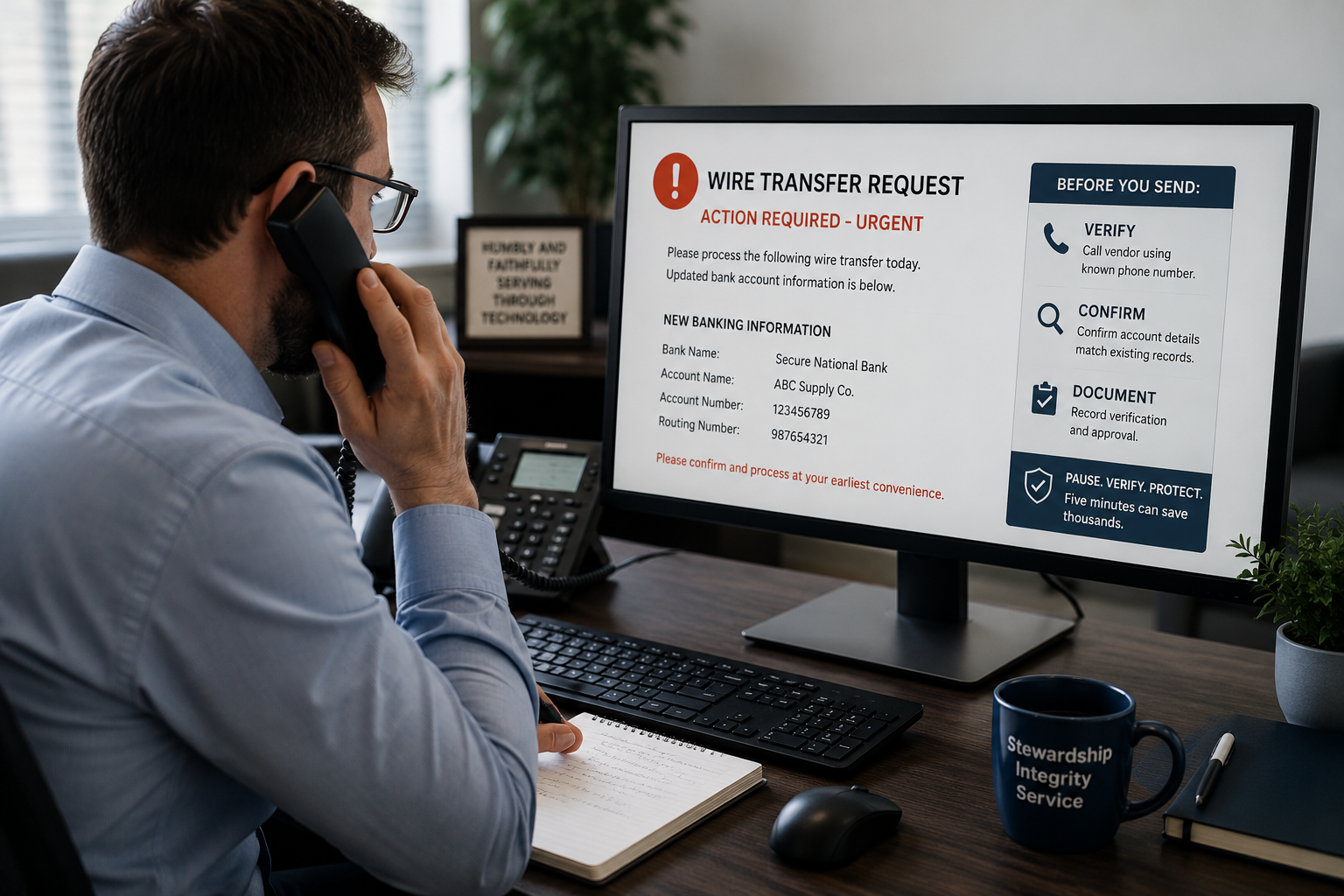

The Costliest Mistakes Often Happen In A Hurry
Most organizations assume financial fraud happens because someone clicked a malicious link or because hackers bypassed sophisticated security controls.
In reality, many financial losses occur because a well-meaning employee acted on an urgent request that appeared legitimate.
The technology may never fail. The firewall may never fail. The antivirus may never fail.
The process fails.
Financial fraud often succeeds because attackers understand human behavior. They know that when people feel pressured, rushed, or distracted, they are more likely to skip verification steps and make decisions they would normally question.
That is why one of the most effective fraud prevention strategies is surprisingly simple: pause for five minutes before sending money or changing payment information.
Those five minutes could save your organization thousands, or even hundreds of thousands, of dollars.
Why Financial Fraud Continues To Grow
Cybercriminals have discovered that it is often easier to manipulate people than it is to break through technology.
Instead of attacking servers or attempting to bypass security software, many attackers focus on convincing employees to voluntarily transfer money, update vendor information, or approve payments.
These attacks are commonly known as Business Email Compromise (BEC) attacks.
According to the FBI’s Internet Crime Complaint Center (IC3), Business Email Compromise consistently ranks among the most financially damaging forms of cybercrime, resulting in billions of dollars in reported losses each year.
The reason is simple.
A successful Business Email Compromise attack often requires nothing more than a convincing email and an employee who feels pressured to act quickly.
The Most Dangerous Word In Financial Fraud: “Urgent”
Think about the language commonly found in fraudulent payment requests:
- “This needs to be completed immediately.”
- “Please process this before the end of the day.”
- “I’m unavailable by phone right now.”
- “The vendor’s banking information has changed.”
- “We need this payment sent within the next hour.”
These messages are designed to create urgency.
Urgency reduces critical thinking.
When people feel rushed, they are less likely to:
- Verify information
- Ask questions
- Follow procedures
- Notice inconsistencies
- Seek a second opinion
Attackers know this. In many cases, urgency is their most effective weapon.
How Modern Financial Fraud Attacks Actually Work
Many people imagine cybercriminals sitting behind multiple computer screens attempting to hack into complex systems.
The reality is often much simpler.
A typical fraud attack may look like this:
Step 1: Research
The attacker studies the organization.
They identify executives, vendors, finance personnel, and payment schedules through public information, social media, websites, and previous data breaches.
Step 2: Establish Credibility
The attacker creates an email account that closely resembles a legitimate vendor or executive.
At a quick glance, the message appears authentic.
Step 3: Wait For The Right Opportunity
The criminal waits until a scheduled payment cycle or a time when staff members are likely to be busy.
Step 4: Create Urgency
A message arrives requesting a wire transfer, banking update, or invoice payment.
The request appears routine but includes a sense of urgency.
Step 5: Receive The Funds
The payment is processed according to the fraudulent instructions.
By the time the mistake is discovered, the funds may already be transferred through multiple accounts.
No malware.
No ransomware.
No sophisticated hacking.
Just social engineering and process failure.
Why Good Employees Sometimes Fall For These Attacks
Nobody wakes up intending to send money to a criminal.
Financial fraud succeeds because good employees are trying to do their jobs efficiently.
They want to be responsive.
They want to be helpful.
They want to keep business moving forward.
Attackers exploit these positive qualities.
That is why fraud prevention should never focus on blame. Instead, organizations should build processes that protect employees from being placed in situations where a rushed decision can have costly consequences.
Good processes protect good people.
The Five-Minute Verification Process
One of the simplest and most effective financial controls is implementing a mandatory five-minute verification process for sensitive financial transactions.
Before approving:
- Wire transfers
- ACH transactions
- Vendor banking changes
- New payment instructions
- Large financial transactions
Pause and follow a structured verification process.
Step 1: Pause
Do not act immediately.
Any request that creates pressure deserves additional scrutiny.
Step 2: Verify
Contact the requester using a separate communication method.
Do not reply directly to the email.
Use a known phone number, established contact information, or another trusted communication channel.
Step 3: Confirm
Verify account numbers, payment details, and transaction information against existing records.
Look for inconsistencies.
Step 4: Document
Record who performed the verification and how it was completed.
Documentation creates accountability and consistency.
Step 5: Proceed
Only after verification has been completed should the payment or change be approved.
The entire process may take less than five minutes.
The protection it provides can last much longer.
A Real-World Scenario
Imagine your accounting department receives an email from a long-time vendor.
The message states that their banking information has changed and all future payments should be sent to a new account.
The email includes the correct company logo, professional language, and accurate invoice references.
Everything appears legitimate.
Without verification, an employee updates the vendor record and processes a scheduled payment.
A week later, the actual vendor contacts your organization asking why payment has not been received.
The money was sent.
Unfortunately, it was sent to a criminal account.
Now the organization may face:
- Financial losses
- Vendor disputes
- Insurance claims
- Internal investigations
- Regulatory concerns
- Significant administrative burden
A brief verification call could have prevented the entire situation.
Why Local Governments And Public Agencies Are Frequent Targets
Local governments face unique challenges when it comes to financial fraud.
Cities, counties, utilities, and public agencies often process large numbers of payments while managing taxpayer resources.
This makes them attractive targets for cybercriminals.
Attackers recognize that public organizations frequently work with:
- Contractors
- Service providers
- Infrastructure vendors
- Grant funding
- Utility payments
- Capital improvement projects
A successful fraudulent payment does not just affect the organization’s finances.
It can also impact public trust.
For government leaders, strong verification processes are not simply financial controls. They are an important part of responsible stewardship of public resources.
Technology Helps, But Process Discipline Matters More
Technology remains an important part of fraud prevention.
Organizations should implement:
- Email security filtering
- Multi-factor authentication
- Endpoint protection
- Security monitoring
- Cybersecurity awareness training
These controls significantly reduce risk.
However, technology alone cannot prevent every social engineering attack.
If an employee voluntarily follows fraudulent instructions, even the best security tools may not stop the transaction.
The strongest protection comes from combining:
- People
- Processes
- Technology
When all three work together, organizations become much more resilient against fraud.
Building A Culture Of Verification
Organizations that successfully prevent financial fraud often share a common characteristic.
Verification becomes part of the culture.
Employees understand that slowing down is not a sign of inefficiency.
It is a sign of responsibility.
They know that asking questions is encouraged.
They understand that even routine requests deserve verification when money or sensitive information is involved.
Most importantly, leadership supports employees who take the time to follow established procedures.
When verification becomes normal, attackers lose one of their greatest advantages: urgency.
Stewardship Sometimes Looks Like Five Extra Minutes
Every dollar your organization manages represents responsibility.
Whether you oversee public funds, client accounts, ministry finances, or business operations, protecting those resources is part of good stewardship.
Criminals depend on rushed decisions and broken processes.
Strong organizations build habits that slow down long enough to verify, confirm, and protect what has been entrusted to them.
Sometimes the most effective cybersecurity control is not a piece of software.
Sometimes it is simply five minutes of disciplined verification before money leaves the account.
At Cross Link Consulting, we help businesses, financial organizations, local governments, and nonprofits strengthen both their cybersecurity posture and operational processes. Technology plays an important role, but well-designed procedures often provide some of the strongest protection against costly mistakes.
We faithfully serve organizations throughout the CSRA, including Augusta, North Augusta, Aiken, Columbia County, Richmond County, Edgefield County, and surrounding communities. If you would like help improving cybersecurity awareness training, financial fraud prevention procedures, or your overall security strategy, we would be honored to help.